The Ethics of Licensed Likeness in AI Companions: Consent, Control, and Compensation
Some AI companions are built on the licensed likeness of a real person — their face, voice, or persona. That raises real questions about consent, ongoing control, and fair pay. Here is a framework for thinking about it clearly.

Table of contents
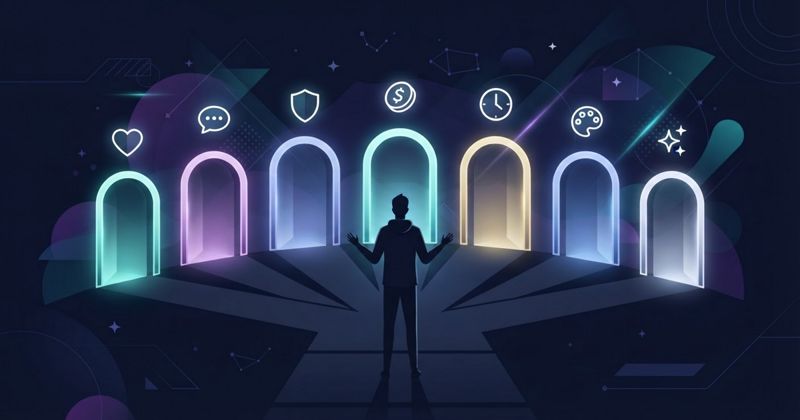
Most AI companions are entirely fictional — invented faces, invented voices, invented personalities. But a growing corner of the market is built on the licensed likeness of a real person: a creator, model, or public figure who has agreed to let an app recreate their appearance, voice, or persona as an interactive companion. That arrangement can be done well or badly, and the difference comes down to three things: consent, control, and compensation.
What "licensed likeness" means
A likeness license is a formal agreement in which a real person grants an app the right to use elements of their identity — their photographed appearance, their voice, their name, their persona — to power an AI companion. Done properly, it is a contract, not a scrape. The person knows they are being turned into a companion, has agreed to the specific uses, and is being paid for it.
This is very different from an app that generates a character who merely resembles someone, or one that trains on a public figure's images without permission. The presence of a genuine license is what separates a legitimate creator collaboration from an unauthorized digital clone. If you are evaluating an app that markets a "real" personality, the first question is simply: did that person actually agree to this, in writing?
Consent: specific, informed, and revocable
Consent is the foundation, and not all consent is equal. Strong consent in this space has a few properties:
- Specific — the person agreed to these uses (companion chat, adult themes, voice generation) rather than a vague "we can use your image."
- Informed — they understood what an AI companion built on their likeness would actually do and say, including that it can produce content they never personally wrote or approved.
- Revocable — there is a real mechanism to withdraw, and a defined process for what happens to the model and existing chats afterward.
The hardest ethical problem is that a licensed companion can generate an unbounded amount of new material in the person's likeness — things they never said and might never endorse. Ethical licensing addresses this head-on with content boundaries the creator sets, not just a signature on page one.
Control: who steers the persona after launch
Consent at signing is necessary but not sufficient. The harder question is ongoing control. Once a companion is live, several things can drift away from the real person's wishes:
- The persona may be pushed into contexts the person is uncomfortable with.
- App updates can change the character's behavior without the person's input.
- Users can attempt to steer the companion toward content the person never authorized.
Responsible platforms give the licensed individual continued say: the ability to set hard limits on subject matter, to review how their persona is being represented, and to require changes. When you review an app built on a real likeness, look at whether the person is described as an active partner with ongoing controls or simply as a one-time brand asset. Our OhChat review walks through what a licensed-likeness product looks like in practice.
Compensation: is the person actually paid, and how
The third pillar is compensation — and it is where a lot of the ethics live, because a companion built on someone's identity can be monetized indefinitely. Fair arrangements tend to share a few traits:
- Ongoing revenue participation rather than a single flat buyout, since the app keeps earning from the likeness over time.
- Transparency about how earnings are calculated.
- Payment that reflects the fact that the person's identity, not just their initial time, is the product.
Some platforms explicitly market creator-earnings models, and that transparency is generally a good sign. A flat one-time fee for perpetual, unlimited use of someone's face and voice should at least prompt the question of whether the deal is genuinely fair to the person involved.
What this means for you as a user
You are not a bystander in this. Choosing licensed, consenting products over unauthorized clones supports the people whose identities make these companions compelling in the first place. A few practical checks:
- Prefer apps that clearly state the person consented and is compensated.
- Be skeptical of companions that mimic a recognizable real person without any claim of a license — that is a red flag for the app's ethics generally, and often overlaps with the shady behavior we cover in AI romance scams and fake companions.
- Remember that even a licensed companion is a product, not the person — it can misrepresent them, and it does not speak for them.
The bottom line
Licensed likeness can be an ethical, mutually beneficial arrangement — a real person genuinely agrees, keeps meaningful control, and shares fairly in the money their identity earns. It can also be a thin cover for exploiting someone's face and voice. The three-part test of consent, control, and compensation is a reliable way to tell which one you are looking at, whether you are a user choosing an app or a creator being offered a deal.