How AI Dating and AI Companionship Are Converging in 2026
AI dating apps and AI companion apps started as different products for different goals. In 2026 the line between them is blurring — dating tools are adding companion-like features, and companions are borrowing dating mechanics. Here is what is converging, why, and what it means for how you choose.

Table of contents
A couple of years ago the distinction was clean. AI dating apps used artificial intelligence to help you meet real people — smarter matching, profile help, conversation suggestions. AI companion apps gave you a relationship with the AI itself, a persona to talk to rather than a tool for finding humans. We laid out that split in detail in AI companion vs AI dating app: what is the difference.
In 2026 that clean line is smudging. Products from both sides are drifting toward the middle, and the categories are starting to overlap in ways that matter when you are deciding what to actually use.
What each side started as
To see the convergence, it helps to remember the starting points.
- AI dating apps were assistants for human connection. The AI worked behind the scenes on matching, or beside you as a coach — helping write a profile, suggesting openers, nudging conversations along. The goal was always a real person on the other end.
- AI companion apps were the relationship. The AI was the counterpart: a character with a persona and memory you talked to for its own sake, not as a stepping stone to meeting someone.
Two different jobs, two different value propositions.
Where they are meeting
The drift is happening from both directions.
Dating apps are adding companion-like features. As matching and messaging get more AI-driven, the assistant starts to feel less like a tool and more like a presence. Some apps offer AI chat partners to "practice" conversation, coaches you talk to at length, or persistent AI helpers that remember your preferences across sessions. The more time you spend talking to the app rather than through it, the more it resembles a companion. Our look at how AI dating apps are changing online dating traces some of this shift.
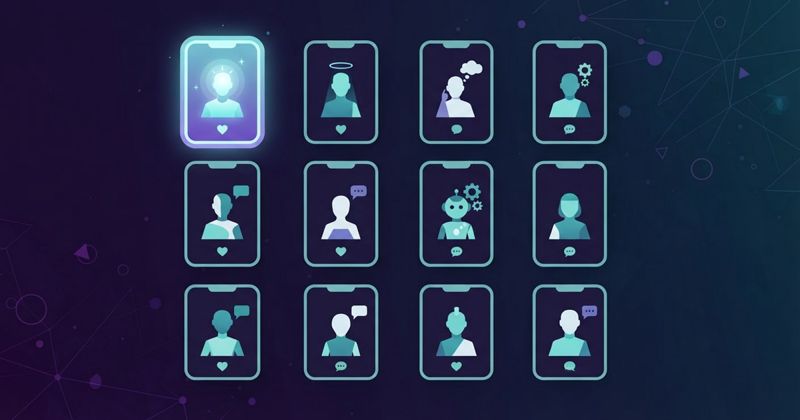
Companion apps are borrowing dating mechanics. From the other side, companion products increasingly adopt the interface language of dating: swiping to choose a character, matching flows, profiles for AI personas, and discovery feeds. The interaction feels like dating even though the counterpart is synthetic.
The result is a growing middle ground where the honest answer to "is this a dating app or a companion app?" is "a bit of both."
Why it is happening
A few forces push the two categories together:
- The same underlying technology. Both rely on the same generation of language models. When the core engine is shared, feature sets naturally converge — anything one side can build, the other can too.
- Engagement economics. Companion-style features — persistent memory, a persona that greets you, ongoing conversation — are very good at keeping people coming back. Dating apps have every commercial reason to adopt them.
- User behavior. Plenty of people use both, and some are open to a spectrum between "help me meet someone" and "keep me company." Products follow that demand into the overlap.
- Familiar interfaces win. Dating's swipe-and-match pattern is understood by millions. Companion apps adopt it because it lowers the learning curve.
What the blur means for you
Convergence is not automatically good or bad, but it changes how you should choose. A few practical implications:
- Be clear about your own goal. The categories blurring makes it easier to drift. If you want to meet real people, check that an app actually delivers that and is not quietly steering you toward talking to an AI instead. If you want companionship, that is fine too — just name it honestly to yourself.
- Read what a product actually is, not how it is labeled. Marketing language is loosening along with the categories. "AI dating" might mean human matching, an AI companion, or a hybrid. Look at the core loop before you pay.
- Cost models are converging too. Companion-style monetization — credits, tokens, tiered plans for richer interaction — is spreading into dating-adjacent products. Our guide on choosing an AI companion app without wasting money applies increasingly to both sides.
- The privacy surface is merging as well. Hybrid apps collect both dating-style personal data and companion-style intimate conversation, which is a broader exposure than either alone. That makes careful account and data hygiene more important, not less.
A quick way to place any app
When a product's category is unclear, ask three questions:
- Who is on the other end — a person, an AI, or both?
- Is the AI a tool that fades into the background, or a presence you talk to directly?
- What does the business want you to do more of — meet people, or keep chatting with the app?
The answers place almost any 2026 product on the dating-to-companion spectrum quickly.
The bottom line
AI dating and AI companionship are converging because they share the same engine, the same engagement incentives, and increasingly the same users. That gives you more choice, but it also means labels tell you less than they used to. The way through is not to pick a category — it is to be clear about what you want from the interaction, then judge each app by what it actually does rather than what it calls itself. In a blurring market, your own clarity is the thing that keeps the choice a good one.